
Blogs
Your ERP Has the Data. Here's Why It's Still Not Helping You.
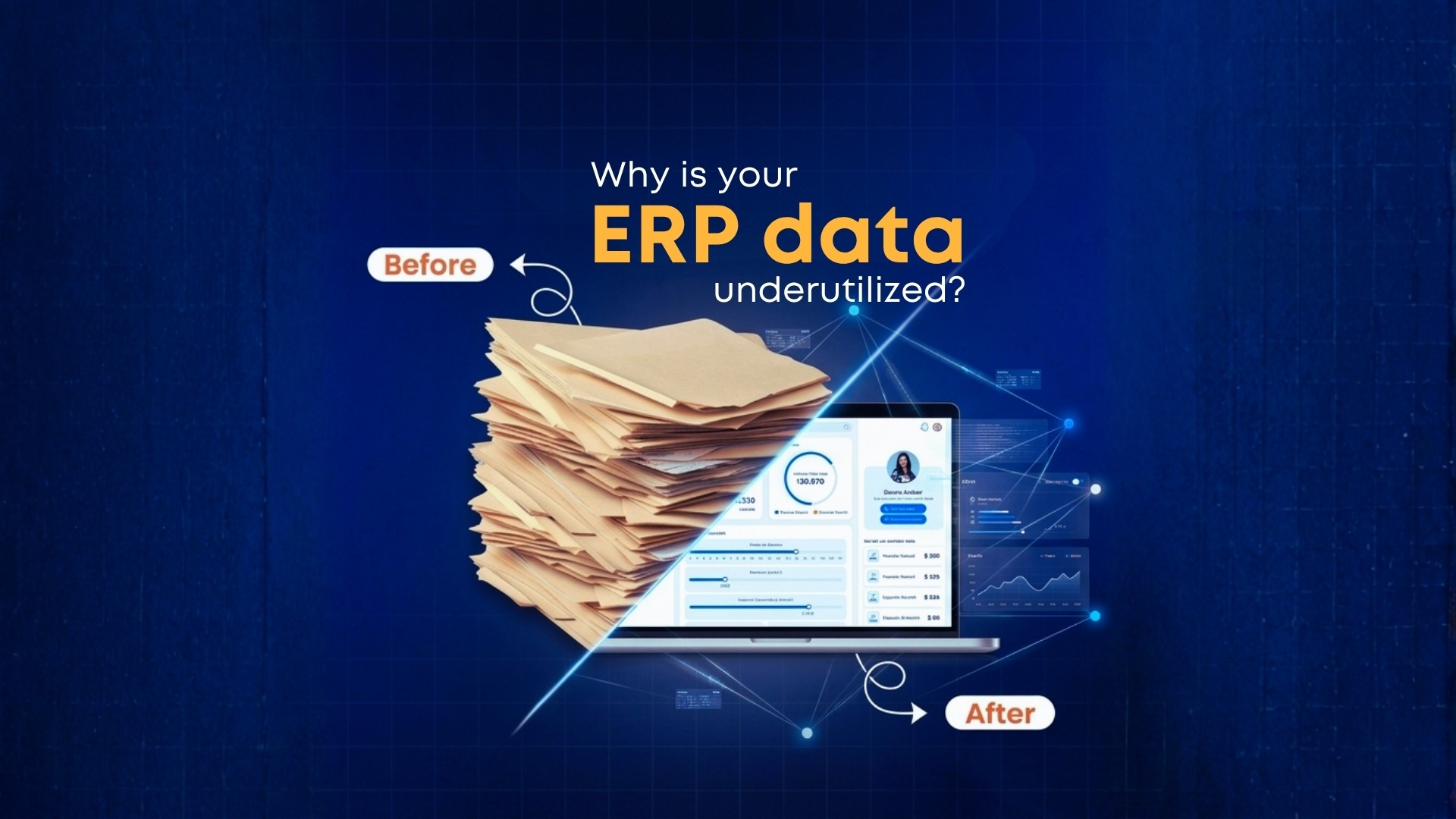
What Is ERP Data Underutilization?
Enterprise Resource Planning (ERP) systems like Microsoft Dynamics 365 and Salesforce are built to centralize everything: finance, operations, inventory, sales, supply chain. The idea is one system, one source of truth. But here is what tends to happen instead. Finance works out of Excel. Sales tracks deals in a separate tool. Operations uses yet another system. Everyone has their own version of the numbers, and no one agrees in the meeting room. The ERP becomes a data warehouse rather than a decision-making engine. That is a significant business risk, not just a technical inefficiency.
Why ERP Data Goes to Waste
1. The System Is Too Hard to Use
ERP platforms were built for power, not simplicity. For a non-technical user like a regional sales manager or a supply chain lead, pulling a basic report can feel like defusing a bomb. When teams hit friction, they stop using the tool. They build workarounds. They create their own trackers. And suddenly, your ERP is just a backend system that IT touches once in a while. The impact is real: slower decisions, lower ERP adoption rates, and your organization continuing to rely on manual reporting long after it should have moved on.
2. Spreadsheet Culture Is Stubborn
It starts with one department. Someone finds it easier to just export the data and work in Excel. Then another team does it. Then another.
Before long, you have five different versions of the same report floating around, and a Monday morning meeting where half the room has different numbers on their slides. This is one of the most common ERP data management challenges. Data silos do not just slow you down. They create blind spots in your business.
3. You Are Only Using It to Look Backwards
Traditional ERP usage is reactive. You check what happened last month. You review last quarter's numbers. You run year-end reports.
That is historical data, not business intelligence.
Modern organizations need their ERP to do more than archive. They need it to signal what is coming: a demand spike, a supplier risk, a cash flow gap before it becomes a crisis. If your ERP only tells you what happened, you are always one step behind your competitors.
4. Bad Data Kills Trust Quickly
Manual data entry introduces errors. A wrong product code here, a duplicate entry there, and suddenly nobody trusts the numbers coming out of the system. Once trust breaks down, people stop using the platform entirely. They revert to what they know: calls, emails, spreadsheets. And your ERP investment starts quietly losing its return. Data accuracy in ERP systems is not a nice-to-have. It is the foundation on which everything else is built.
How to Actually Fix It
You do not need a new ERP. You need to activate the one you have.
Use AI to Make Data Accessible
Instead of navigating complex dashboards, users can simply ask: "Which product line had the highest return rate last quarter?" or "Which region is behind on this month's target?" AI-powered ERP tools convert raw data into plain language answers. This improves ERP user adoption significantly because the barrier to access drops. You do not need to be a data analyst to get useful information out of the system.
Automate Data Entry and Sync
Manual entry is slow and error-prone. Automation can capture data from emails, invoices, and external platforms and sync it directly into your ERP. This reduces human error, keeps data current, and frees up your team from repetitive admin work. Clean inputs lead to trustworthy outputs.
Go Beyond Reporting: Enable Predictive Insights
Modern ERP platforms can do more than report on the past. With the right configuration and tools, they can alert you to inventory shortfalls before they become stockouts. They can flag demand trends early. They can help your finance team see a cash crunch three months before it hits. This is the shift from ERP as a record-keeping system to ERP as a live business intelligence platform.
Connect ERP with CRM and Other Systems
An ERP that talks to your CRM gives your teams a complete picture. Sales can see inventory levels before making a promise to a client. Finance can see what deals are in the pipeline before finalizing budgets. Operations can align delivery capacity with incoming orders.
When systems are integrated, the whole organization moves faster and with more confidence.
What This Means for Your Business
Companies that actively use their ERP data make faster decisions, reduce operational costs, and spot growth opportunities earlier. Companies that do not are essentially flying with a blindfold on. The gap between these two types of organizations is growing. ERP optimization is no longer a project for large enterprises only. It is a competitive advantage for any business that wants to scale efficiently.
Your ERP is not broken. It is just underused. The data is already there. What is missing is the right strategy to turn that data into decisions.
Whether it is enabling AI-powered queries, improving data quality, automating integrations, or connecting your ERP with your CRM, the path forward does not require starting over. It requires activating what you already have. If your ERP still feels more like a storage room than a control room, it is time to change that.