
If you run operations or IT at a mid-size manufacturing company, your supply chain is under more pressure in 2026 than it has been in years. Tariffs, labour gaps, demand volatility, and rising customer expectations are hitting at the same time.
The companies that are holding up well have one thing in common — they upgraded how their supply chain works, not just what tools they use.
We've worked on over 300 manufacturing supply chain implementations. The ones that failed weren't failed by the software. They were failed by waiting too long to act.
Here are the five shifts that separate manufacturers who are growing margin from those who are losing it.
1. If You Don't Have a Digital Twin, You're Flying Blind
Most mid-size manufacturers still rely on lagging data — reports that tell you what went wrong last week, not what's going wrong right now.
A digital supply chain twin changes that. It's a live virtual model of your production environment. It runs alongside your actual operations and flags issues before they become stoppages.
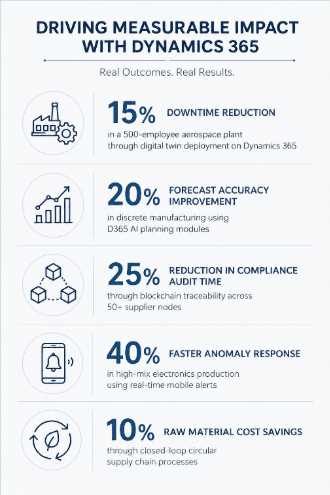
One aerospace component manufacturer with 500 employees cut unplanned downtime by 15% in a single quarter after deploying a Dynamics 365 digital twin overlay on their CNC fleet. Not in a year. In one quarter.
What digital twins do for manufacturers:
Test "what-if" scenarios on demand spikes without touching the shop floor
Identify bottlenecks in high-mix production before they show up in delivery delays
Cut setup errors by 30% through virtual commissioning of new assembly lines
Reduce mean time to repair by 25% through guided maintenance workflows
The most common objection is integration complexity. Legacy MES data sitting in silos is the usual blocker. The fix isn't always a massive IT project. NSquare has connected shop-floor PLC feeds into Copilot Studio to drive the twin, and deployed Azure IoT Edge for mid-size sites in under four weeks.
If someone asks you what the ROI on a digital twin looks like — the honest answer is 10 to 20% reduction in unplanned downtime within six months, with payback typically in 9 to 12 months.
2. Spreadsheet Forecasting Is a Liability in 2026
If your demand planning runs on spreadsheets, you're reacting to history. And in 2026, history isn't a reliable guide.
AI-driven planning inside Dynamics 365 Supply Chain Management uses Copilot-enhanced demand signals to forecast volumes with 95% confidence intervals. That's not a pitch — that's what it delivers when the data pipeline is set up correctly.
A 1,200-employee discrete manufacturer improved forecast accuracy by 20% and cut inventory carrying costs by 12% in six months after switching from spreadsheet-based planning to D365's AI modules.
What this looks like in practice:
Microsoft Copilot in D365 suggests production schedules based on live demand signals
Salesforce Agentforce brings real-time customer order data into demand sensing
Machine learning flags slow-moving SKUs before they tie up working capital
OTIF (on-time in-full) improves by 5 to 7% within three months of go-live
The prerequisite is a clean data pipeline. ERP, CRM, WMS, and IoT data need to flow into a single source — Azure Synapse or D365 Data Lake. NSquare built six Azure Data Factory templates specifically for mid-size manufacturing environments, deployed in under three weeks.
The question manufacturers ask most: Is AI planning worth it if our data isn't clean? The answer is — start with the pipeline. The planning improvement follows.
3. If You're Still Running Batch Reports, You're Always Behind
Monthly or even weekly batch reports don't work when your shop floor moves in real time. By the time an exception shows up in a report, it's already a problem.
Real-time visibility means streaming data operations that can react in minutes, not days.
What manufacturers are deploying in 2026:
LoRaWAN sensors on conveyors and presses feeding continuous health metrics into D365 Supply Chain Insights
Azure Digital Twins for spatial asset mapping on the shop floor
Power BI dashboards embedded directly in D365 and Salesforce for executive-level views
Automated exception workflows routing critical issues to the right person via Teams or Slack
One result worth noting: a 350-person electronics assembler cut response times to part anomalies by 40% after pushing real-time alerts directly to floor managers' phones using NSquare's WhatsApp Dynamics connector. Not a dashboard they had to log into. A message that found them.
Reporting delays dropped by 30% across NSquare's telematics implementations. The shift isn't complex. It starts with getting sensor data off the floor and into a system that can act on it.
4. Multi-Tier Supply Chains Need More Than Vendor Portals
If you're managing 20, 50, or 100+ suppliers on purchase orders, emails, and manual check-ins, you're trading on trust. And trust breaks under pressure.
Blockchain in supply chain isn't just a buzzword for large enterprises. Mid-size manufacturers are using it practically — to create an immutable record of purchase orders, proof-of-delivery events, and material provenance across supplier tiers.
A mid-size auto parts supplier ran a blockchain proof of concept across 50 suppliers. They traced material provenance from raw steel to stamped chassis components and cut compliance audit time by 25%.
How this integrates with platforms manufacturers already use:
Microsoft Azure Blockchain Service templates spin up private supplier networks without building from scratch
Salesforce blockchain plugins embed supplier nodes directly in CRM workflows
Goods are tokenized automatically as they clear quality checkpoints
The compliance consideration most manufacturers miss: when ledger data crosses borders, GDPR and CCPA requirements apply. Chain-of-custody protocols need to be documented for audit readiness before go-live, not after.
5. Sustainability Reporting Is No Longer Optional
ESG compliance used to be something large public companies worried about. In 2026, mid-size manufacturers are facing it directly — from customers who require it, regulators who are moving toward mandating it, and procurement teams using it as a supplier selection filter.
The operational case is just as strong. An 800-employee electronics manufacturer saved 10% on raw materials by closing the loop on PCB scrap and reinjecting it into new board production.
What Dynamics 365 for Sustainability enables:
Material passports tracked at the BOM level for recyclability and recycled content thresholds
Azure Machine Learning predicting overproduction events and adjusting batch sizes before waste happens
Carbon footprint reports aligned to SASB and GRI standards generated automatically
ESG dashboards that are board-ready in under two days
Waste reduction through yield optimization has delivered 8% improvements in NSquare pilot runs. The measurement infrastructure — energy usage, water consumption, recycling rates by site — is the foundation. Without it, sustainability reporting is manual and slow.
What Manufacturers Actually Want to Know
What are the most important supply chain trends for manufacturers in 2026? Digital twins for real-time visibility, AI-driven demand planning, live data streaming from the shop floor, blockchain for supplier traceability, and sustainability measurement. Each one addresses a specific vulnerability — downtime, forecast error, slow response, supplier risk, and regulatory exposure. Mid-size manufacturers who move on even two or three of these in 2026 will operate differently from competitors who don't.
How does Dynamics 365 Supply Chain Management help manufacturers specifically? D365 SCM connects production planning, demand forecasting, warehouse management, and supplier collaboration in one platform. In 2026, Copilot and AI capabilities are embedded directly into planning and scheduling workflows — not as add-ons, but as native functionality. For manufacturers running Finance, Supply Chain, and Manufacturing modules together, the real value is the single data model across all three.
How long does it take to see ROI from a supply chain digital transformation? Based on NSquare's implementations, digital twin deployments show downtime reduction in three to six months. AI planning improvements show up in forecast accuracy and inventory carrying costs within six months. Payback on full supply chain transformation depends on scope, but mid-market deployments typically achieve it in 9 to 18 months.
Is blockchain practical for mid-size manufacturers, or is it just for large enterprises? It's practical. The proof-of-concept model across 50 suppliers, described above, was run by a mid-size auto parts supplier not an enterprise with a dedicated tech team. The entry point is lower than most manufacturers expect, especially with Azure Blockchain Service templates and Salesforce connector plugins.
What should manufacturers prioritize first? Start with visibility. You can't improve what you can't see. Whether that's a digital twin, real-time sensor data, or a live Power BI dashboard getting accurate, current operational data is the foundation for everything else on this list.
NSquare's Track Record in Manufacturing Supply Chain
NSquare Xperts is a Microsoft Solutions Partner and Salesforce Certified Partner with over 300 manufacturing supply chain implementations. If you're evaluating Dynamics 365 Supply Chain Management for your manufacturing operations or looking to optimize an existing implementation, we've built the blueprint.
--
Author: Kirit Mandavgane, Chief Strategy Officer at NSquare Xperts
A seasoned Microsoft technology strategist specializing in Microsoft Dynamics 365, the Microsoft Power Platform, and Microsoft Copilot. He advises organizations on CRM, ERP, automation, and AI initiatives, helping them accelerate digital transformation and achieve measurable business outcomes.


