
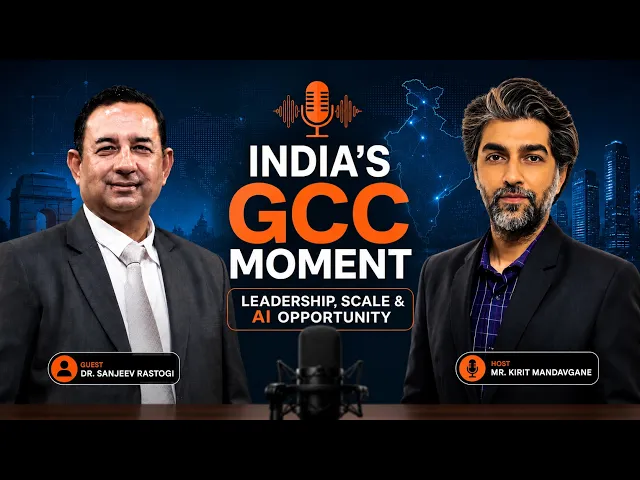


Summary: GCCs in India are shifting from cost-driven delivery centers to strategic business catalysts. On NSquare Xperts' CXOTalks, hosted by CSO Kirit Mandavgane, Dr. Sanjeev Rastogi of Adani Group explains why AI-driven GCC transformation only works when process discipline comes first, and why leadership, not technology, will decide which GCCs create business value.
For years, the conversation around GCCs in India centered on cost, talent availability, and moving work from global headquarters to India. Today, the bigger question is different: how does a GCC create measurable business value?
That was the central theme of the latest CXOTalks episode from NSquare Xperts, hosted by CSO Kirit Mandavgane, featuring Dr. Sanjeev Rastogi, Group Head at Adani Group. Recorded at NSquare's World Trade Center office in Pune, this is NSquare's first video podcast episode. Dr. Rastogi brings more than three decades of experience across multiple organizations and verticals and now with Adani Group, and the conversation covers AI, operations, talent, and leadership in equal depth.
Why GCCs in India Are Moving Beyond Cost Savings
Dr. Rastogi describes GCCs as moving through a clear maturity curve. Early centers focused on transitioning work to India. The next phase moved toward transformation and process improvement. Mature centers began taking on R&D, innovation, and specialized capability. The current phase is about integrating AI directly into business strategy.
This changes what a GCC is. It's no longer purely an execution center. It can become a strategic capability that helps the parent organization transform and grow, what Dr. Rastogi calls a potential "game-changer catalyst "- with India increasingly at the center of that shift.
AI Needs Process Discipline Before It Needs Technology
One of the strongest points from the conversation: AI cannot fix a broken or fragmented process. At Adani Group, different businesses run on different systems, so the approach has been to standardize the underlying process first, even when the technology stack differs.
Processes get digitized, documented through SOPs, and made consistent across the organization. That foundation is what makes AI usable at scale.
Dr. Rastogi's approach is direct: look at the full process end to end, not one isolated step. A bot can solve a single problem, but real transformation comes from understanding the complete journey, defining the outcome, and measuring the result. Start with the process, define the outcome, implement the technology, measure the impact, then course correct.
How AI Is Changing GCC Talent
AI's impact on GCC talent will be real. Transactional and rule-based work is increasingly automatable. But Dr. Rastogi frames this as a skills shift, not simply a headcount reduction. As machines take on repetitive work, people need to focus more on judgment, analysis, and decision-making, which makes reskilling a genuine business priority, not a side initiative.
The Future of GCC Leadership Is Human.
Even with AI transforming operations, Dr. Rastogi's leadership philosophy stays firmly people-first, built on three principles: dedication, desire, and discipline. Dedication is commitment to the work and the people. Desire is the curiosity to keep learning as technology shifts. Discipline is what makes a GCC reliable at scale.
He also points to servant leadership, diversity of thought, transparency, and personal connection with employees as non-negotiables, especially for today's multi-generational workforce. His core message: leadership can't happen from a distance.
GCCs Must Move Beyond Cost Arbitrage
Perhaps the biggest takeaway: cost cannot remain the primary GCC strategy. Cost savings may justify setting up a GCC initially, but they're not a sustainable long-term differentiator. Real value comes from data science, data engineering, AI, technology management, and process ownership, capabilities that let GCC professionals move into genuine global leadership roles.
This is where the GCC story becomes bigger than outsourcing. India can become a place where global organizations build capability, own process, and create innovation, not just execute work at lower cost.
Also Read: How Much Does It Cost to Set Up a GCC in India?
What Should GCC Leaders Focus on Next
Dr. Rastogi's advice is direct: have a seat at the table. That means a clear vision, a defined blueprint, and strong alignment with the parent organization, and it means no longer measuring success only through cost and turnaround time. Those are baseline expectations. The real question is what business value the GCC is creating, which means influencing decisions and building KPIs tied to business outcomes, not just delivery metrics.
FAQs
What does it mean for a GCC to move beyond cost arbitrage?
It means a GCC stops measuring success only through cost savings and turnaround time and starts being evaluated on the business value it creates, including innovation, process ownership, and direct influence on enterprise strategy.
Why does AI transformation in a GCC require process discipline first?
AI cannot fix a broken or fragmented process. Standardizing and documenting processes before applying AI ensures the technology is automating something consistent and measurable, rather than automating dysfunction.
How is AI changing talent needs inside GCCs?
AI is automating transactional and rule-based work, which shifts talent needs toward judgment, analysis, and decision-making. This makes reskilling and upskilling a core business priority rather than an optional initiative.
What leadership qualities matter most for GCC leaders in the AI era?
Dr. Sanjeev Rastogi points to dedication, desire, and discipline, paired with servant leadership and personal connection with employees, as the foundation for leading a GCC reliably at scale even as technology changes rapidly.
--


