
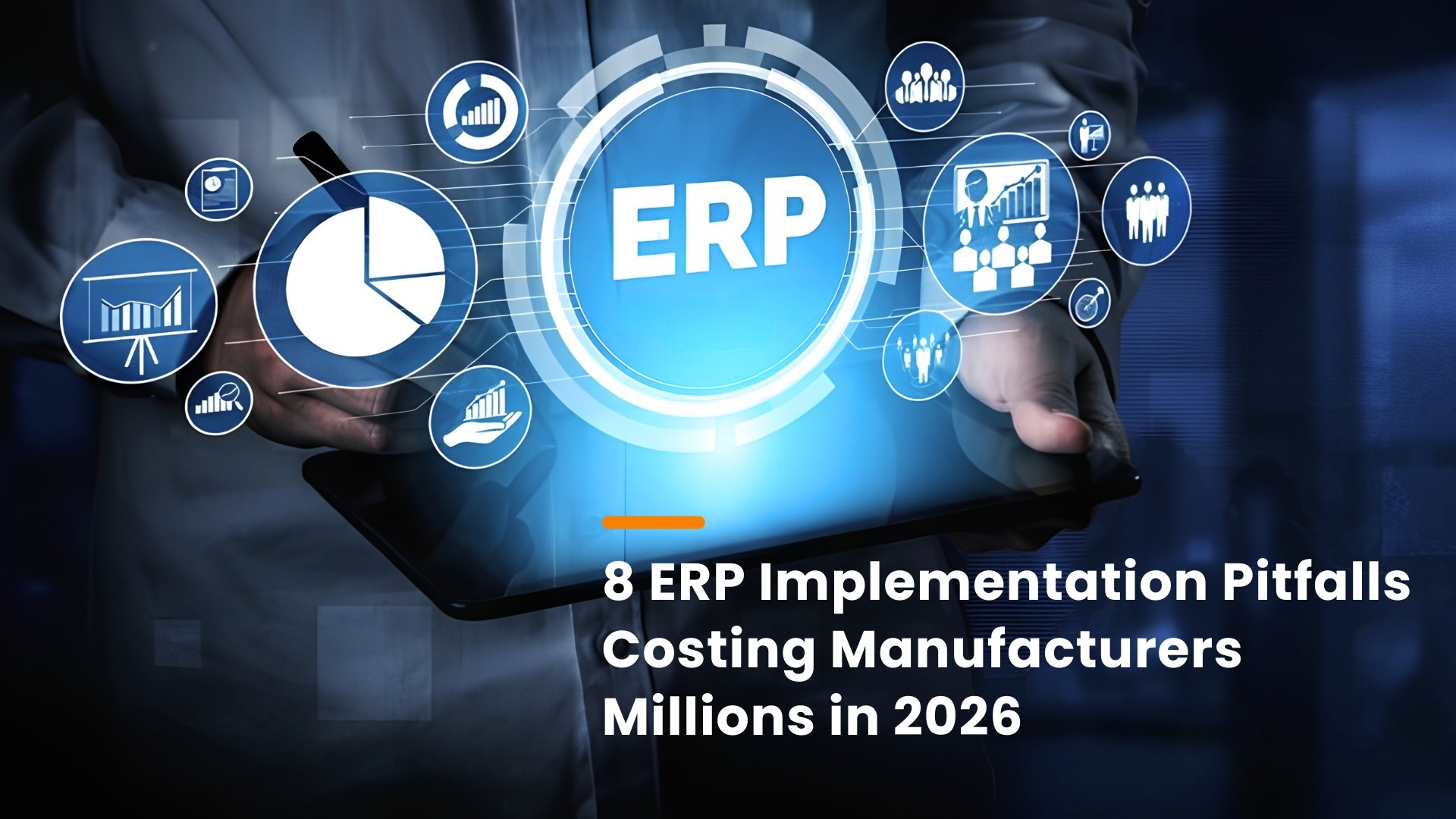
Most manufacturing ERP projects don't fail because of the software. They fail because of what happens before, during, and after go-live decisions made under pressure, integrations skipped to save time, and teams left without the tools or training to actually use what was built.
NSquare Xperts has completed 300+ CRM and ERP implementations for mid-market manufacturers across the US, UK, UAE, Singapore, and India. These are the 9 manufacturing ERP implementation challenges we see most often in 2026 — and what it actually costs when you get them wrong.
Whether you're running Dynamics 365, Salesforce Manufacturing Cloud, or evaluating your options, this guide covers what the top 5 search results won't tell you, the real-world cost of each mistake.
Rushing Dynamics 365 Without an Agentic AI Roadmap
What it costs: $300K+ in unplanned downtime. One mid-tier plant implemented core financials and inventory first, then realized too late that equipment sensors weren't integrated with Copilot. Weekly production spikes were logged but never analyzed. The result: three months of missed anomaly detection and a $300K downtime bill.
What most teams get wrong about Copilot
Most teams assume Copilot is a chat assistant. In Dynamics 365 Business Central, agentic AI can trigger automated maintenance orders, flag anomalies before they become failures, and approve BOM changes without human bottlenecks. In April 2026, Microsoft embedded agentic AI natively into Business Central — teams without a pre-built AI roadmap are already behind.
The late-stage AI mapping trap
When site engineers aren't included in AI workflow mapping until after UAT, approval loops default to manual email chains. One plant saw 48-hour delays on BOM changes and forced rework on critical prototypes — all because decision workflows were mapped too late.
Configuring agentic AI triggers during discovery for an Ohio automotive parts plant cut go-live errors by 40% and reduced downtime by 25%.
Common warning signs:
No Copilot trigger design in the discovery phase
AI use cases not tied to plant KPIs
Decision workflows mapped after UAT
Skipping predictive quality checks in QA configuration
Applying Generic SAP Templates to Mid-Market Operations
What it costs: $200K in custom code plus 3 months of added timeline. Large SIs deploy standard SAP templates built for 5,000+ headcount enterprises. A 450-employee engine components manufacturer had to retrofit shop-floor barcode scans to fit a generic material staging flow — an oversight that added six weeks of gap-fit analysis before the real work could begin.
Why standard templates fail on the shop floor
Standard SAP routing assumes rigid assembly lines. A Just-In-Time cell with flexible lot sizes, specialty coatings lines, or custom production flows doesn't fit. One Michigan plant resorted to offline spreadsheets because the ERP template didn't account for their cell structure — defeating the entire purpose of the rollout.
The Hidden KPI Problem
Failing to embed OEE and scrap rate metrics natively forces manual data pumps from shop-floor devices to SAP reports, delaying critical insights by up to two weeks — every single month.
Custom production modules for a 400-employee parts maker reduced total customization cycles by 25% and cut month-end close by five days.
Skipping Hands-On Change Management
What it costs: 70% spike in manual workarounds within the first week. A 320-person assembly line went live with new picking processes. Supervisors got a two-hour slide deck. Operators ignored the system entirely — and manual logs spiked 70% in seven days.
Why e-learning doesn't work on the shop floor
Generic e-learning modules rarely stick for operators handling physical workflows. Scenario-based workshops — where teams work through real process steps in the actual system — cut support tickets by 60% in our experience. Hands-on coaching drives adoption eight times faster than standard training.
The supervisor engagement gap
Omitting supervisors from design sessions means alerts don't reach the right people. One plant saw critical downtime notifications go unanswered for hours during a weekend shift — because the notification routing was designed without supervisor input.
On-site change workshops increased user adoption by 60% across 30 manufacturing projects and reduced go-live support calls by 40%.
Ignoring FIESA Field Service Integration Testing
What it costs: 15 unlogged service calls and £45K in SLA fines. When mobile connectivity wasn't tested in network-poor zones, a UK equipment maker paid the price. Field service is your frontline for uptime — and it breaks in the places nobody thought to test.
Offline mode is not optional
Without offline caching, technicians working in basements, rural sites, or trenches revert to paper forms that never sync. One deployment saw 18% data loss on inspection results — all because the offline scenario was never tested before go-live.
Inventory sync delays cause cascade failures
Technicians dispatched without correct parts lists — because inventory sync lagged 24 hours — drives back-orders, repeat visits, and SLA breaches. Real-time FieSA hooks to live inventory prevent this entirely.
Underestimating Salesforce Manufacturing Cloud Complexity
What it costs: $120K in lost orders plus a five-week remediation. A London-based OEM treated Manufacturing Cloud as a standard CRM. When ERP sync mappings failed during a peak product launch, orders stalled — and it took five weeks to untangle the data model.
Manufacturing Cloud is not a standard CRM
Manufacturing Cloud uses custom objects for forecasts and capacity that don't map to standard Opportunity fields. One supplier's team tried forcing this mapping — triggering silent data loss that took weeks to detect. Service contracts, entitlements, and field service all require dedicated configuration, not generic CRM setup.
Cross-cloud load testing is non-negotiable
Without full load testing across CPQ, Salesforce DM, and ERP under spike conditions, quote approvals can fail at exactly the worst moment — during a new product rollout. This is not a theoretical risk.
Ungoverned Power Platform Customization
What it costs: Two hours of daily downtime, a data breach investigation, and delayed month-end reporting. Power Apps and Power Automate promise quick wins — but ungoverned citizen development creates technical debt fast. One DIY Canvas app crashed on 100 concurrent users, halting data entry across an entire shift.
Security and governance can't be an afterthought
Apps with elevated privileges accessing sensitive ERP tables are a compliance liability. A Singapore automation line inadvertently exposed PII to unauthorized roles through an ungoverned Power App — triggering a formal data breach investigation. Without governance guardrails, shadow IT proliferates and the ERP becomes unreliable.
Performance testing before you scale
Canvas apps pulling entire ERP tables instead of filtered queries create 12-second list loads. Power Automate flows can throttle under high throughput, delaying month-end production reports by a full day. These issues only surface under load — test before you roll out.
Overlooking Communication Gaps
What it costs: 4-hour response delays, plus regulatory fines totalling £60K and AED 350K. WhatsApp is the default channel for field technicians in most markets. Without embedding it in Dynamics, techs juggle two systems, and context gets lost between them.
App hopping kills field productivity
Switching between Dynamics and a separate messaging app costs 20 minutes per service case. Multiply that across a team, and it's significant daily waste. Without automated notifications, only 80% of technicians receive timely priority updates when schedules shift.
Compliance is a mandatory requirement, not a feature
In the UK and UAE, failing to track WhatsApp opt-ins triggers regulatory audits. This is not a grey area, the fines are real, and the audit trail must exist inside your CRM, not in an external chat app.
Failing to Drive User Adoption Post Go-Live
What it costs: 50% of supervisors revert to Excel within weeks of launch. Even a technically sound ERP fails when users don't trust it. A 380-person operation saw half of its supervisors default to legacy spreadsheets after go-live, and data quality collapsed.
Role-based training is not optional
Generic sessions that cover every function for every role bore operators and leave managers under-prepared. Separate tracks for maintenance, production, and finance improve relevance and retention. Micro-learning — 3-minute video clips for specific transactions — has reduced helpdesk tickets by 65% at plants that commit to it.
Feedback loops catch issues before they compound
Regular pulse surveys and rapid-response support teams catch critical issues early. One plant identified a BOM mapping error within 48 hours of go-live because a feedback loop was already running. Without it, that error might have propagated for weeks.
Key Takeaways for Manufacturing ERP Leaders
Manufacturing ERP implementation challenges in 2026 are not primarily technical — they're organizational, process-driven, and adoption-related. The software works when the implementation does. Here's what the best-performing rollouts have in common:
AI roadmap designed before go-live, not added after
Process templates built for your actual shop floor, not a generic enterprise
Supervisors and operators in the room during design, not just UAT
Field service, telephony, and messaging were integrated and tested before launch
Role-based training with feedback loops running from day one
The manufacturers who win with ERP in 2026 are not the ones with the biggest budgets or the most well-known implementation partners. They're the ones who treated implementation as a business transformation project, not a software installation.
--
Author: Kirit Mandavgane, Chief Strategy Officer at NSquare Xperts
A seasoned Microsoft technology strategist specializing in Microsoft Dynamics 365, the Microsoft Power Platform, and Microsoft Copilot. He advises organizations on CRM, ERP, automation, and AI initiatives, helping them accelerate digital transformation and achieve measurable business outcomes.


