

Ask a CIO whether they should bet a five-year platform decision on Dynamics 365, SAP, or Salesforce, and "who has the biggest market share" is almost never the real question. The real question is whether the platform is still gaining ground, still getting invested in, and still validated by people who evaluate ERP and CRM systems for a living.
Those three things are checkable. Market share headlines usually aren't, at least not to the precision most blog posts claim.
Here's what actually holds up.
Where Dynamics 365 sits today
By share of the global ERP market, Dynamics 365 is not the leader. Analyst-tracking estimates that blend data from multiple research houses put SAP around 22-24%, Oracle's combined Fusion and NetSuite lines around 11-13%, and Microsoft's Dynamics 365 Finance & Operations plus Business Central lines around 8-10%. Infor sits further back, around 5-6%.
These are indicative ranges, not a single precise figure from one named report, and any post claiming an exact decimal-point share from "the Gartner report" should be read with suspicion. Gartner does not publish ERP vendor market share as a standalone metric.
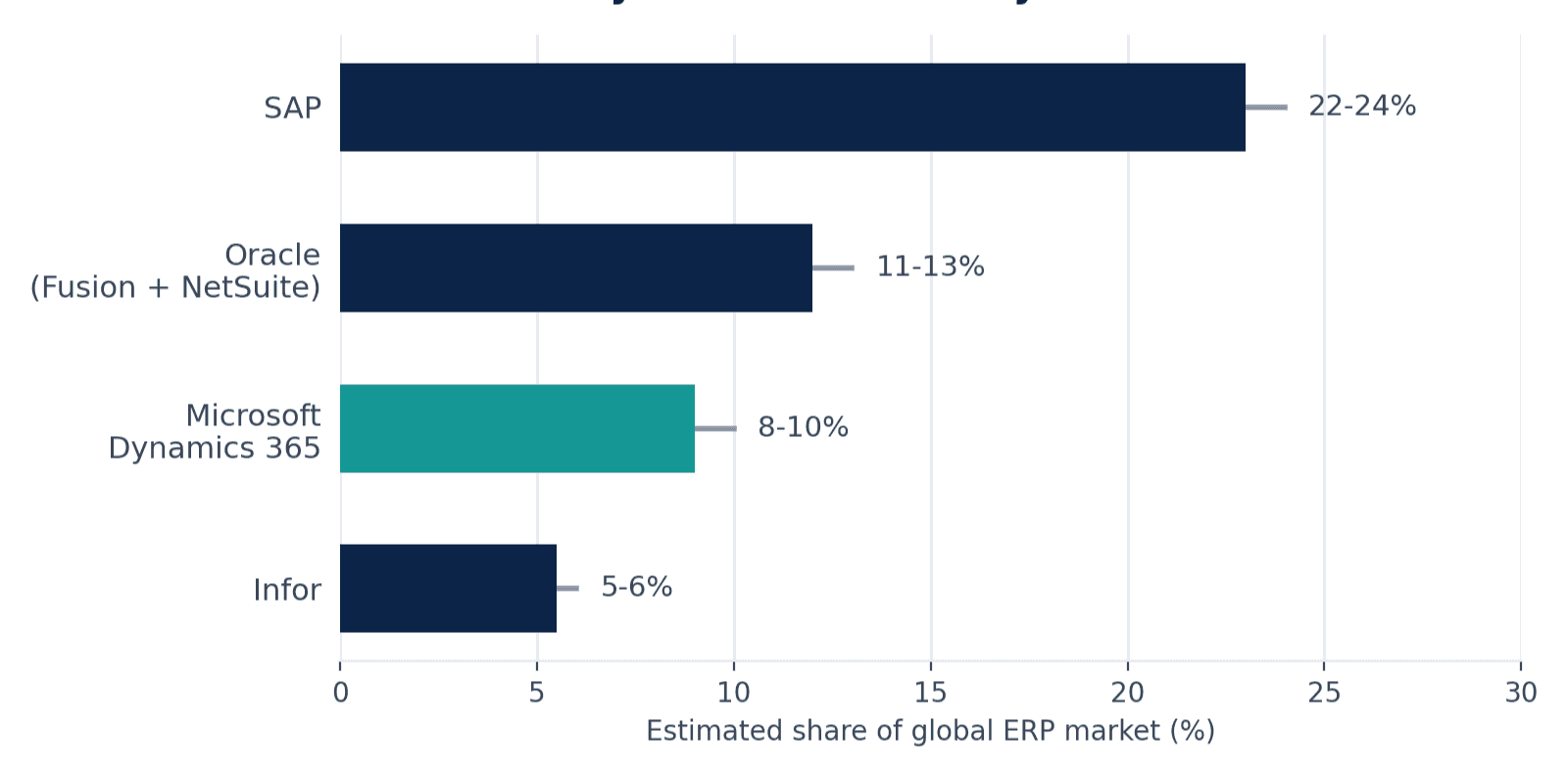
That ranking, on its own, is a reason to look past Dynamics 365. The more useful question is what's happening underneath it.
The number that matters more than rank
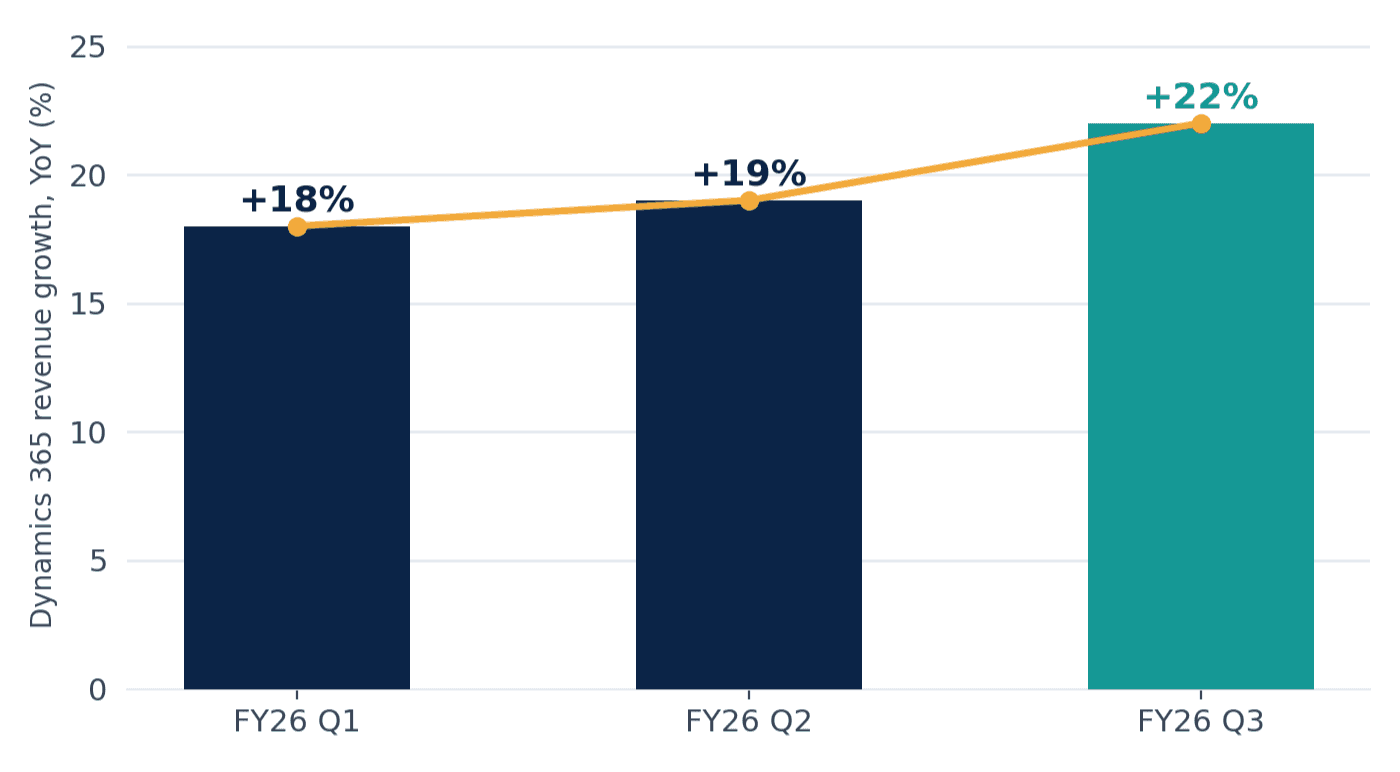
Microsoft's own quarterly earnings show Dynamics 365 revenue growth accelerating through fiscal 2026, not holding steady. Growth went from 18% in fiscal Q1, to 19% in Q2, to 22% in Q3, each quarter reported directly in Microsoft's investor releases. That's an unusual pattern for a product line already generating billions in revenue: most mature enterprise software slows down as it scales, and Dynamics 365 is doing the opposite.
A platform gaining share slowly but accelerating in growth is a different bet than one with a bigger current footprint but flattening momentum. For a CIO planning a multi-year rollout, the trend line is arguably more decision-relevant than the current snapshot.
Independent validation, not just Microsoft's own numbers
Growth claims from a vendor's own earnings are worth checking against outside opinion, so here's the outside opinion. Microsoft's Dynamics 365 was named a Leader in three separate Gartner Magic Quadrant reports for cloud ERP in late 2025: Cloud ERP for Service-Centric Enterprises, Cloud ERP for Product-Centric Enterprises, and Cloud ERP Finance.
Separately, Dynamics 365 Sales was named a Leader in the 2026 Gartner Magic Quadrant for CRM Sales Platforms, for the sixteenth consecutive year.
Being named a Leader in a Magic Quadrant is about execution and vision, not a market share number, and Gartner's own methodology is explicit about that distinction. Four separate Leader placements across ERP and CRM in the same twelve-month window is still a meaningfully different signal than a single vendor claim.
Why the growth curve is bending now
Gartner's own research points to a plausible reason Dynamics 365's growth is accelerating rather than plateauing: embedded AI is reshaping what buyers expect from ERP. Gartner projects that 62% of cloud ERP spending will go toward AI-enabled solutions by 2027, up from just 14% in 2024, and predicts that finance teams using cloud ERP with embedded AI assistants could see financial close cycles shorten by 30% by 2028.
Microsoft has leaned hard into that shift with Copilot-based agents built directly into Dynamics 365 workflows. Whether that specific bet pays off for a given business depends on the business, but the direction of the market and the direction of Microsoft's product roadmap are, for once, pointing the same way at the same time.
What this means if you're actually choosing a platform
Don't pick a platform because it currently has the biggest share. SAP's installed base reflects decades of enterprise lock-in more than 2026 buying preference, and a large installed base doesn't automatically mean it fits a specific business's compliance needs, integrations, or team skill set.
Look instead at momentum, independent validation, and whether the vendor's AI roadmap is backed by real product releases rather than a slide deck.
On those three measures, Dynamics 365 has a genuinely stronger case in 2026 than its market share rank alone would suggest. That's a more useful takeaway for a buying decision than a percentage that can't be traced back to a real source.
If you're weighing Dynamics 365 against Salesforce for your own environment, we've broken that comparison down in detail for midmarket teams, and the same momentum-over-headline-share logic applies whether you're a first-time buyer or rethinking an ERP rollout that's already underway.
NSquare works through exactly that kind of platform decision with enterprise teams across banking, insurance, healthcare, and education, grounded in what each platform can actually deliver for a specific business rather than a headline ranking.
FAQs
Is Microsoft Dynamics 365 the market leader in ERP?
No. By most analyst-blended estimates, SAP holds the largest global ERP share, followed by Oracle's combined ERP products. Dynamics 365 trails both by current share, though it's growing faster than either on a percentage basis.
Is Dynamics 365 growing faster than SAP?
Yes, on a percentage growth basis for fiscal 2026. Microsoft reported Dynamics 365 revenue growth accelerating from 18% to 22% across its first three fiscal quarters. Percentage growth on a smaller base isn't the same as closing the absolute revenue gap, so both numbers matter for a full picture.
Is Dynamics 365 an ERP or a CRM?
Both. Dynamics 365 Finance and Supply Chain Management (formerly Finance & Operations) function as ERP, while Dynamics 365 Sales, Customer Service, and related apps function as CRM, all built on the same underlying platform.
Why has Dynamics 365 been named a Gartner Magic Quadrant Leader multiple times?
Gartner named Dynamics 365 a Leader across three 2025 Cloud ERP Magic Quadrants and, separately, in the 2026 Magic Quadrant for CRM Sales Platforms for the sixteenth straight year. Magic Quadrant placement reflects Gartner's assessment of a vendor's ability to execute and completeness of vision, not market share.
Where can I verify these Dynamics 365 growth numbers myself?
Microsoft publishes exact revenue growth figures for Dynamics 365 in its quarterly earnings releases and investor relations filings, available directly on microsoft.com/investor. Gartner's Magic Quadrant recognitions are covered in Microsoft's own Dynamics 365 blog and in Gartner's published research summaries.
-
Author: Kirit Mandavgane, Chief Strategy Officer at NSquare Xperts
A seasoned Microsoft technology strategist specializing in Microsoft Dynamics 365, the Microsoft Power Platform, and Microsoft Copilot. He advises organizations on CRM, ERP, automation, and AI initiatives, helping them accelerate digital transformation and achieve measurable business outcomes.


