
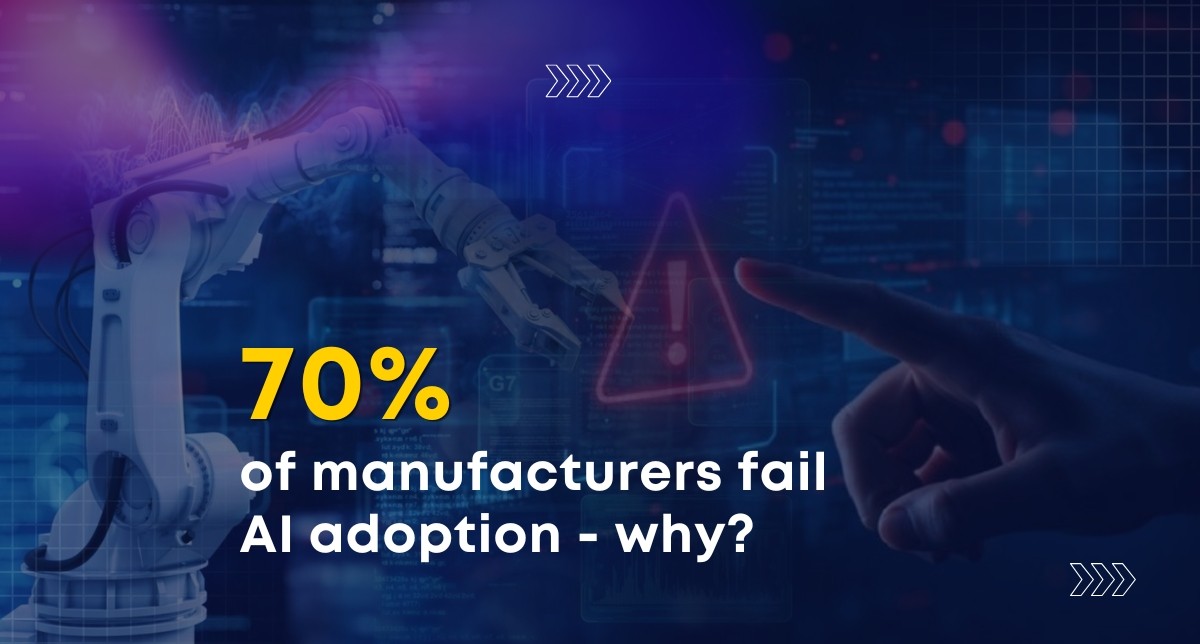
70% of manufacturing AI initiatives fail to deliver expected outcomes.
That is not a future risk.
It is already happening.
And while most companies think the problem is the technology, the real issue is something far more basic: Adoption.
A lot of manufacturers are using AI.
Far fewer are actually making it work.
That gap is where most AI projects break down.
The Real Problem Is Not Execution
Most manufacturers approach AI the same way they approach a new machine:
Buy it
Install it
Expect output
But AI does not work like a machine.
It does not produce results just because it has been implemented.
It needs:
Trust
Clean data
Integration
People who are willing to use it properly
Without that, even the best model becomes just another unused system.
Why AI Adoption Stalls on the Factory Floor
One major reason is employee anxiety.
When teams feel AI may replace their role, they do not fully adopt it.
They use it superficially, or they quietly work around it.
That means the tool exists, but the behavior does not change.
Example:
A predictive maintenance model may flag an issue early.
But if the floor team does not trust it, they may ignore the alert and wait for the breakdown anyway.
That is not a model problem.
That is an adoption problem.
The Data Problem Is Even Bigger
Manufacturing also has a serious data problem.
Most plants still run on decades-old ERP systems that are disconnected from MES, quality systems, and field data.
That creates a broken foundation.
AI needs:
Clean data
Connected systems
Real-time inputs
Clear ownership
But in many plants:
Sensor data is siloed
OT and IT systems do not talk
No one owns shop-floor data end to end
So even when the AI solution is strong, the data feeding it is weak.
And weak data creates weak decisions.
Why Pilots Never Become Production
Only a small portion of companies are able to move an AI project from proof of concept to production.
That is why so many projects stay stuck in what people call:
Pilot Purgatory
The demo looks good.
The leadership is impressed.
But the system never scales.
Why?
Because the pilot was built to showcase AI, not to solve an operational problem.
What the Successful 26% Do Differently
The manufacturers that get real results do not start with a tool.
They start with a problem.
1. They Solve a Specific Problem, Not a General One
They do not say:
“We want AI in our plant.”
They say:
“We lose 14% of production time to unplanned downtime on Line 3. How do we cut that in half?”
That kind of clarity changes everything.
2. They Fix the Data Before the Model
AI cannot save a plant that runs on spreadsheets and tribal knowledge.
Before implementation, they ask:
Can our systems produce clean, structured, real-time data?
If the answer is no, the work begins there.
Not with the model.
With the data.
3. They Integrate Instead of Building from Scratch
Internal development sounds impressive.
But in many cases, integrating the right tools works better.
External partnerships and purchased AI tools often lead to better outcomes than trying to build everything in-house.
For most manufacturers, that is the faster and more reliable route.
4. They Involve the Floor Team Early
This is one of the biggest differences.
The companies that succeed include:
Line managers
Maintenance leads
Quality supervisors
These are the people who will actually use the system.
If they are not involved on Day 1, adoption will fail on Day 365.
The Real Outcome Comes From Better Questions
The manufacturers seeing strong results are not necessarily buying better tools.
They are asking better questions before they buy anything.
That is why some companies:
Reduce downtime
Improve productivity
Scale AI effectively
While others get stuck in endless experimentation.
Final Thought
AI in manufacturing is not a technology decision.
It is an operations decision that happens to involve technology.
The companies that understand this will move faster.
The companies that do not will keep running pilots that never become production.