
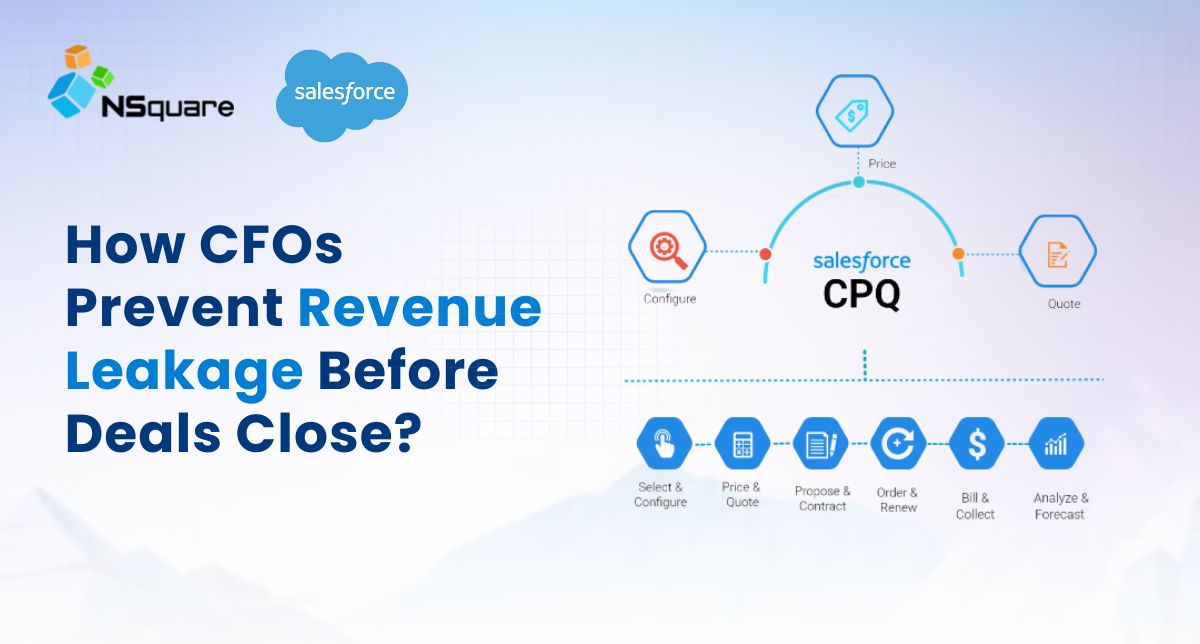
Revenue leakage in manufacturing rarely begins in production or invoicing. It starts earlier, during quoting. Pricing exceptions, manual configurations, inconsistent discounting, and delayed approvals quietly erode margins before finance teams ever see the numbers.
This is why Salesforce CPQ for manufacturing is increasingly driven by CFOs, not just sales leaders. What was once seen as a sales enablement tool has become a pre-deal financial control system.
For manufacturing CFOs in the USA and the Middle East, where configurable products, regional pricing, and distributor-led sales models dominate, CPQ is now a governance decision, not a technology upgrade.
What Is Revenue Leakage in Manufacturing?
Revenue leakage in manufacturing refers to avoidable margin loss that occurs before an order is finalized. These losses often remain invisible until forecasts miss targets or gross margins decline quarter after quarter.
Common sources include:
- Manual quoting errors
- Unauthorized or inconsistent discounting
- Region-specific pricing deviations
- Slow approval cycles driven by email and spreadsheets
When quotes are created outside a governed system, finance teams lose control at the exact point where margins are negotiated.
This is where manufacturing CPQ software plays a critical role.
Why Manufacturing Quotes Create Margin Risk for CFOs?
Manufacturing sales environments are structurally complex because products are configurable, pricing varies by customer, geography, and volume, and approval thresholds depend on margin impact, not deal size alone.
When this complexity is managed through spreadsheets and informal approvals, margin risk becomes inevitable.
Sales teams under pressure to close deals often optimize for speed, not profitability. Small pricing decisions made repeatedly, without financial visibility, compound into significant revenue leakage.
Salesforce CPQ for manufacturing addresses this by embedding pricing rules, margin thresholds, and approval logic directly into the quoting process. Pricing discipline becomes systemic, not discretionary.
How Salesforce CPQ Improves Manufacturing Sales Governance
Salesforce CPQ replaces manual judgment with structured, auditable logic.
Product configurations follow predefined rules by preventing invalid or non-manufacturable combinations. Pricing is calculated automatically using customer agreements, volume tiers, regional price books, and multi-currency logic.
When discounts exceed CFO-defined thresholds, automated approval workflows are triggered, and governance is enforced without slowing down sales execution.
For CFOs, this translates into:
- Fewer pricing disputes
- Reduced rework
- Real-time margin visibility before deal commitment
Sales velocity improves, but margin integrity remains intact.
Core Salesforce CPQ Capabilities for Manufacturing Finance Teams
A modern CPQ platform must support financial control at scale.
Salesforce CPQ enables:
- Rule-based product configuration
- Contract and customer-specific pricing
- Tiered and volume-based discounting
- Multi-currency and regional price governance
- Automated, auditable approval workflows
Because Salesforce CPQ integrates natively with CRM, ERP, and billing systems, data consistency is maintained from quote to cash. This directly improves forecasting accuracy and financial reporting confidence.
Salesforce CPQ as a Financial Control Layer
ERP systems govern revenue after orders are booked. Salesforce CPQ governs revenue before it is committed.
Industry analysis consistently shows that most margin erosion happens prior to order booking. Salesforce CPQ closes this gap by enforcing financial discipline at the point of negotiation.
For manufacturing CFOs, Salesforce CPQ is no longer a sales tool. It is a front-line financial governance system.
How Salesforce CPQ Improves Forecast Accuracy for Manufacturing CFOs
Forecast accuracy depends on disciplined pipeline data.
When every quote follows consistent configuration, pricing, and approval logic, finance teams gain reliable insight into expected margins and revenue timing.
This consistency reduces quarter-end surprises, improves capital planning, and strengthens executive confidence in forecasts.
For CFOs managing volatile input costs and regional pricing pressure, this predictability is a competitive advantage.
Salesforce CPQ vs Other Manufacturing CPQ Solutions
Manufacturers often evaluate platforms such as Oracle CPQ or SAP CPQ. These solutions can work well in tightly coupled ERP environments.
Salesforce CPQ stands out for organizations that require:
- High sales adoption
- Faster configuration cycles
- Flexible pricing governance
- End-to-end visibility within CRM
For CFOs, the differentiator is balance. Salesforce CPQ delivers control without introducing operational friction.
Manufacturing Case Example: What Changed After Salesforce CPQ
A global industrial equipment manufacturer operating across North America and the Middle East struggled with margin inconsistency. Quotes were built in spreadsheets, approvals happened over email, and finance visibility came late in the sales cycle.
After implementing Salesforce CPQ for manufacturing, the organization standardized configurations, embedded pricing rules, and automated approvals based on margin thresholds.
Within months:
- Pricing disputes declined
- Approval cycles accelerated
- Forecast reliability improved
The biggest shift was not speed. It was predictability.
Final Takeaway for Manufacturing CFOs
Revenue leakage in manufacturing rarely starts in finance. It starts in quoting.
Salesforce CPQ for manufacturing gives CFOs the ability to enforce pricing discipline, protect margins, and improve forecast accuracy before revenue is committed.
For manufacturers in the USA and the Middle East managing complex sales models and regional pricing pressure, Salesforce CPQ is becoming a cornerstone of modern financial governance