
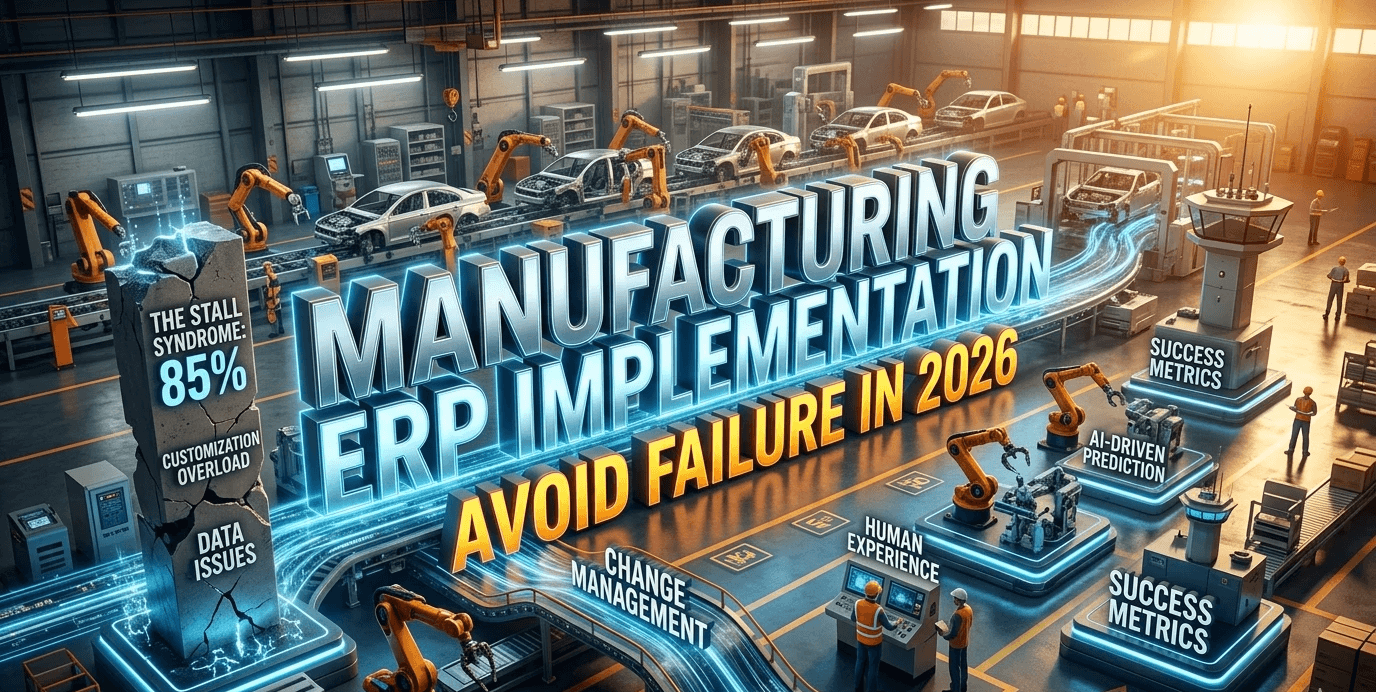
We have reviewed 300 manufacturing ERP implementations. The ones that failed had one thing in common, and it was not the software. It was the approach.
In 2026, manufacturing ERP implementation challenges are at an all-time high. Most mid-market manufacturers under 1,000 employees will see their ERP projects derail, not because Dynamics 365 F&O or Infor is the wrong choice, but because the implementation behind it was built for someone else's business.
If you are a CTO or operations leader evaluating ERP right now, this guide is written for you.
Why ERP Implementations Keep Failing in Manufacturing
The most common answer you will hear is "poor planning." That is true but incomplete.
Here is what the data actually shows.
In a 420-employee UK aerospace supplier, go-live was delayed by nine months because global templates ignored plant-level work order variances. In an automotive components plant in Michigan, Oracle's standard route sequencing left key manual inspections untracked, pushing scrap rates up 2.7%. A mid-sized manufacturer with facilities in Texas and Dubai failed its ISO audit because VAT and multi-country payroll rules were never configured correctly.
Three different companies. Three different ERP platforms. One shared problem: a one-size-fits-all implementation from a large SI that had never worked inside a plant like theirs.
NSquare's post-mortem analysis across failed projects shows 65% of delays stem from inadequate domain expertise, not software limitations. Large firms like Accenture or Deloitte save time upfront by applying global templates, but those templates generate expensive customizations downstream, erode ROI, and extend timelines well past the original forecast.
The Real Causes Behind Mid-Market ERP Failures
Shallow Requirements Gathering
A 350-person Ohio parts supplier spent 12 weeks in discovery only to uncover six missing BOM variants during UAT. That is a $400K problem that a single deep-dive workshop would have caught on day one.
Most mid-market ERP failures trace back to this moment. When requirements gathering is treated as a checkbox rather than a structured process, the gaps surface at the worst possible time: during testing, or after go-live.
Ignoring Change Management Until It Is Too Late
When a 750-employee French automotive supplier skipped early stakeholder alignment, user resistance skyrocketed. Adoption stalled at 48% after go-live. The system worked. The people did not use it.
Effective ERP change management must begin at project kickoff, not two months before launch. It requires C-suite sponsorship, cross-functional steering committees, and a communication plan that reaches the shop floor, not just the boardroom.
Underestimating Integration Complexity
At a 200-employee tool manufacturer, integrating MES and legacy SCADA systems without proper API mapping added $250K in custom code. This is one of the most consistently underestimated line items in mid-market ERP budgets.
The fix is not more developers. It is better architecture upfront iPaaS accelerators and prebuilt connectors that eliminate the need for custom code.
How Long Does a Manufacturing ERP Implementation Take?
This is one of the most searched questions among mid-market operations leaders, and the honest answer is: it depends on scope, but a realistic range is 6 to 12 months for a full Dynamics 365 F&O or Infor rollout.
Variables that extend timelines include the number of sites, integration complexity with MES and PLM systems, and the depth of data migration required. A phased, agile deployment model starting with core financials and inventory, then layering in shop floor and CRM, can bring the first go-live down to 4 to 6 months without sacrificing system integrity.
NSquare completed a data migration for a 600-person automotive stamping plant in Michigan in six weeks. A phased multi-site Dynamics 365 F&O rollout for a 500-employee UK aerospace supplier was delivered in eight months. Speed is achievable but only when the methodology is built for mid-market manufacturing, not adapted from an enterprise playbook.
Data Migration: Where ERP Projects Quietly Break Down
Data migration is rarely glamorous. It is also where most mid-market ERP implementations quietly fall apart.
An automotive forging plant found 18% duplicate records in their ERP tables before migration began. A 900-employee electronics manufacturer had part numbers with inconsistent unit measures, leading to a $340K inventory reconciliation error after go-live. A 1,200-employee plastics firm went live and had auditors flag 7% of cost rollups as unverifiable within the first quarter.
Each of these failures had the same root cause: data was treated as a technical task rather than a business-critical workstream.
The right approach starts with data profiling, cleansing, deduplicating, and consolidating records before any transformation begins. Transformation rules must normalize UOM and material codes upfront. And before go-live, a validation dashboard should cross-check sample records against legacy ledgers and generate audit-proof logs. There should be no surprises post-migration.
What Is the ROI of ERP for Mid-Sized Manufacturers?
ROI for mid-market manufacturers typically ranges from 150 to 250% over three years. The gains come from lower inventory carrying costs, faster financial closes, improved on-time delivery, and reduced manual effort across finance and operations.
Some manufacturers recoup their investment in 12 to 18 months. One mid-market OEM on NSquare's program hit 115% of projected ROI within six months by actively monitoring and optimizing 12 adoption KPIs from transaction counts to employee satisfaction scores.
The difference between realizing that ROI and missing it almost always comes down to two things: how well the system is adopted, and how tightly it is integrated with the systems around it.
How to Improve ERP User Adoption in Manufacturing
A system that nobody uses delivers zero ROI. This is obvious, yet adoption remains the most chronically underfunded part of every mid-market ERP project.
A 550-person automotive components manufacturer cut training days by 40% by building role-specific superuser sessions for production supervisors. A mid-sized CNC shop linked operator KPIs to real-time Power BI dashboards and Microsoft Copilot prompts, boosting transactions per hour by 18%. A 300-employee UK supplier ran weekly feedback sprints post-go-live, uncovering a missing quality inspection step in D365 F&O that was causing defect escapes. Fixing it reduced defects by 23% within two months.
The pattern across all three is the same: adoption improves when training is tailored by role, reinforced with visible performance data, and followed by structured feedback loops. Blended learning videos, on-floor coaching, and AI-driven simulations drive retention far better than classroom sessions alone.
Solving ERP Integration Challenges in Manufacturing
ERP does not operate in isolation. In a mid-sized manufacturing environment, it needs to talk to MES, PLM, CRM, field service platforms, and communication tools reliably, in real time.
This is where integration complexity bites hardest.
A 400-employee electronics assembler struggled to sync OEE data from its MES into Business Central, delaying variance reporting by days. A mid-size medical device maker tried manual CSV imports between PLM and ERP and faced a 45% failure rate. At a 1,000-employee contract manufacturer, delayed sales-to-production handovers caused line stoppages because the data handoff between Salesforce and Dynamics 365 F&O was not automated.
Out-of-the-box iPaaS accelerators and prebuilt connectors resolve most of these scenarios without custom code. Bidirectional data flows between ERP, PLM, and CRM can be automated so that design changes cascade instantly and order status is visible on the shop floor in real time.
For field service operations, FieSA built on Dynamics 365 Field Service, reducing truck rolls by 28% at a 200-employee industrial pump supplier by delivering optimized technician routes based on parts availability and IoT sensor data. Call Integra CTI cut call resolution times by 35% at a 150-employee tooling firm through click-to-dial, screen pops, and automatic ticket creation. And WhatsApp Dynamics reduced communication lag between plant supervisors and field engineers to under two minutes at a 500-employee machine shop.
Integration is not a technical afterthought. It is where the ROI lives.
What Are the Key Steps to a Successful ERP Deployment?
Based on 300+ implementations across mid-market manufacturers, these are the steps that consistently separate successful projects from stalled ones:
Deep-dive requirements workshops on day one. Not a two-week email chain. A structured, facilitated process that surfaces every process nuance, regulatory requirement, and integration dependency before a single line of configuration is written.
Change management that starts at kickoff. Executive sponsorship, a cross-functional steering committee, and a communication plan that reaches every level of the organization, including the shop floor.
Phased, agile deployment. Core financials and inventory first. Shop floor and CRM next. Smaller sprints allow rapid course corrections and prevent the catastrophic scope creep that derails big-bang implementations.
Rigorous data migration with validation. Cleanse before you migrate. Validate before you go live, audit-proof your records from day one.
Integrated testing of all connected systems. MES, PLM, CRM, field service, and communication platforms all need to be tested as a system, not in isolation.
A specialized mid-market partner. Not a firm that adapts enterprise playbooks. A team that has done this exact project, for this exact type of manufacturer, dozens of times.
Key Takeaways
65% of manufacturing ERP failures stem from inadequate domain expertise, not software limitations.
One-size-fits-all implementations from large SIs generate expensive downstream customizations that erode ROI.
Data migration is the most underestimated workstream in mid-market ERP projects. Treat it as business-critical from day one.
ERP change management must start at project kickoff, not two months before go-live.
Mid-market manufacturers typically see 150–250% ROI over three years when adoption and integration are executed well.
Phased, agile deployment reduces go-live risk and can bring core modules live in 4 to 6 months.
Integration with MES, PLM, CRM, and field service platforms is where the real ROI is realized and where most projects underinvest.
Evaluating ERP for your manufacturing operation in 2026? Schedule a free consultation now
--
Author: Kirit Mandavgane, Chief Strategy Officer at NSquare Xperts
A seasoned Microsoft technology strategist specializing in Microsoft Dynamics 365, the Microsoft Power Platform, and Microsoft Copilot. He advises organizations on CRM, ERP, automation, and AI initiatives, helping them accelerate digital transformation and achieve measurable business outcomes.


