
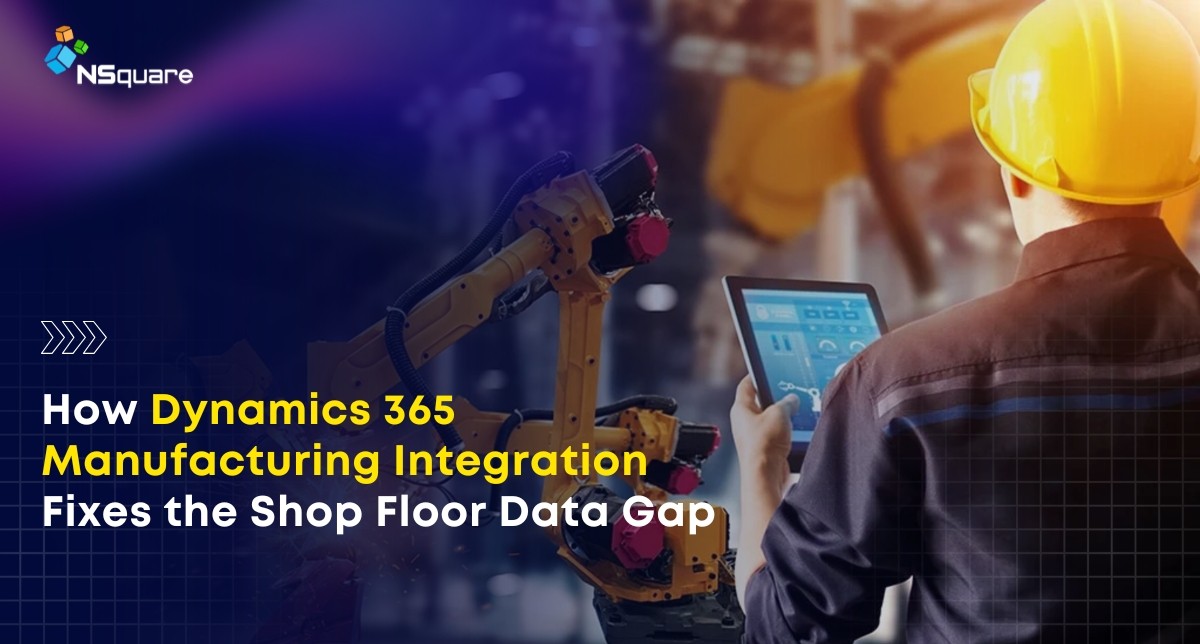
Dynamics 365 manufacturing integration closes the data gap between what your ERP planned and what your shop floor actually produced. It delivers real-time OEE visibility, automated quality alerts, traceable batch records, and the live data feed that makes Microsoft Copilot's AI recommendations actionable. For mid-market manufacturers running below 60% OEE, the ROI case is typically positive within the first year.
The implementation succeeds or fails on two things: how thoroughly the shop-floor process is mapped before the build begins, and whether the connector architecture is modular enough to scale without expensive rework. Get those two right, and the rest of the project follows a predictable path.
Mid-market manufacturers running Dynamics 365 face a problem that rarely shows up on any implementation checklist. The ERP knows what was planned. The shop floor knows what actually happened. And between those two realities sits a data gap that costs the average mid-market operation hundreds of thousands of dollars a year in missed schedules, bloated overtime, and quality failures that could have been caught in real time.
Dynamics 365 manufacturing integration -- connecting your ERP with a Manufacturing Execution System (MES) -- is the direct fix. This guide covers how it works, what it delivers, what it costs, and the exact questions operations leaders should be asking before they start.
What Is a Manufacturing Execution System and Why Does It Matter for Dynamics 365?
A Manufacturing Execution System is the software layer that lives between your shop floor and your ERP. It monitors work orders in real time, captures machine states and cycle times, enforces quality checks, and tracks materials from raw input to finished good. It operates at what the ISA-95 standard calls Level 3 -- between the SCADA/PLC layer (machine control) and the ERP layer (business planning).
Without an MES, your Dynamics 365 environment is flying partially blind. ERP plans what to produce. MES tracks what is actually being produced, at what efficiency, and why things went wrong. When those two systems are not connected, production cost accounting is distorted, capacity planning is based on estimates rather than actuals, and the weekly OEE review becomes a debate about which spreadsheet to trust.
The core ERP modules in Dynamics 365 Finance and Operations cover work orders, inventory, and financials. They are not designed to capture cycle times, machine anomaly signals, or shift-level defect rates in real time. That is not a criticism of the platform -- it is a description of where MES fits in, and why Dynamics 365 manufacturing integration is a separate, necessary project.
Business Central or Finance and Operations: Which Supports MES Integration?
This is one of the first questions mid-market manufacturers ask, and the answer depends on your production complexity.
Dynamics 365 Supply Chain Management (part of the Finance and Operations family) supports discrete, process, and lean manufacturing with native shop floor control, quality management, and MES integration via OData, Dataverse, and REST APIs. This is the right path for manufacturers with 200 or more users, multi-plant operations, or complex BOMs.
Dynamics 365 Business Central Premium handles lighter manufacturing for companies in the 10--200 employee range. It covers production orders, BOMs, and basic capacity planning. MES connectivity is achievable but requires more custom middleware work than the Supply Chain Management path.
If your shop floor runs 50 or more machines across multiple work centers, Finance and Operations with a dedicated MES connector will almost always deliver a faster ROI than trying to extend Business Central beyond its core design.
How Dynamics 365 Manufacturing Integration Actually Works
The Architecture: What Sits Between PLCs and D365
An ERP-MES connector normalizes data flowing from PLCs, SCADA systems, and sensors into a format that Dynamics 365 can use. A well-designed connector architecture looks like this:
Sensor data is captured via OPC UA or MQTT protocols at the machine level. An edge gateway filters and pre-processes events locally before transmission. Middleware -- typically Azure IoT Hub in a Microsoft ecosystem -- queues messages and handles volume spikes. Azure Functions map sensor payloads into Dynamics 365 work order entities. Power BI surfaces the resulting data on real-time dashboards for supervisors and operations managers.
In a machine tools manufacturer in Pune, this kind of modular, API-first connector reduced network latency by 40% versus a point-to-point integration built earlier in the plant. The modular approach also meant that when the plant scaled from 50 to 200 machines, the connector architecture extended without a full rebuild.
Data Latency: The Metric That Actually Matters
One of the most common questions from operations leaders is how fast the data actually moves. In a properly configured Azure IoT pipeline integrated with Dynamics 365 Supply Chain Management, data ingestion delays can be reduced from 15 minutes or more (common with manual or batch-sync setups) to under 30 seconds. At a 350-employee electronics enclosure manufacturer in the UK, that reduction meant supervisors could intervene on a line stoppage before the next shift inherited the problem rather than discovering it the next morning.
Without this near-real-time feed, Microsoft Copilot's AI-driven demand and production recommendations inside Dynamics 365 are working from stale data. The AI recommendations are only as good as the inputs they receive. This is why Dynamics 365 manufacturing integration is a prerequisite -- not an add-on -- for getting full value from Copilot in a manufacturing context.
Real-Time Production Monitoring and OEE: What Good Looks Like
Overall Equipment Effectiveness is the composite metric that multiplies Availability, Performance, and Quality into a single number. Industry benchmarks for mid-market discrete manufacturers typically sit between 40% and 60%. World-class is 85% or above. The distance between where most plants start and where integrated MES can take them is significant.
In an aerospace parts plant, baseline OEE measured 45% before integration. After three months of automated downtime logging, real-time MES alerts feeding Dynamics 365, and shift-level accountability dashboards, OEE climbed to 70%. That 25-point improvement translated to approximately $850,000 in additional annual throughput value at that plant's production scale. At mid-market volumes, even a 5% OEE gain typically reaches six-figure impact.
The dashboards that drive these results refresh every 10 to 15 seconds. Operators see downtime reasons, scrap percentages, and machine state changes without leaving their workstation. Supervisors receive automated alerts -- via WhatsApp Dynamics notifications or voice escalations through a CTI connector -- when anomalies cross preset thresholds. In a pharmaceutical coating facility in London, that alert system caught sealant temperature deviations before a full batch rejection, avoiding $200,000 in scrap over three months.
Compliance, Traceability, and Audit Readiness
For manufacturers in regulated sectors, medical devices, pharmaceuticals, aerospace, food processing, Dynamics 365 manufacturing integration carries a compliance dimension that is often underestimated during scoping.
A compliant traceability system tags raw materials and subassemblies with serial IDs at every production step. When those IDs are captured by the MES and synced continuously with Dynamics 365 batch records, recall resolution shrinks from weeks to days. At a 1,200-employee medical device manufacturer, mapping 18-level BOMs into Dynamics batch records reduced recall investigation time from two weeks to two days.
On the quality side, automated inspection triggers fire when MES metrics deviate from tolerance. At an automotive shock absorber facility in Texas, defect reports dropped 60% after integrating MES alerts with the Dynamics 365 quality module. Corrective actions were linked directly to the production record, creating a closed-loop documentation trail that satisfied both internal auditors and customer quality requirements.
Audit trails in Dynamics 365 Finance and Operations capture parameter changes with timestamps and user attribution. A chemicals processor in Singapore used this capability to generate FDA-compliant batch records in under five minutes per batch -- a 75% reduction in documentation time versus their previous manual process.
What Does MES Integration with Dynamics 365 Cost?
This is the question that often gets deferred to the end of a conversation, when it should be near the beginning.
The cost range for a full Dynamics 365 manufacturing integration project -- covering connector architecture, middleware configuration, dashboard setup, and user training -- varies significantly by plant complexity and machine count. For a mid-market manufacturer with 50 to 150 machines, a well-scoped project from a specialized implementation partner typically runs between $80,000 and $250,000. Large system integrators working on the same scope can run two to three times that figure.
The variables that move the number most are legacy equipment compatibility, the number of data sources being integrated (PLCs, SCADA, quality sensors, barcode scanners), and how much custom middleware work is required for non-standard protocols. Manufacturers with OPC UA-ready equipment and modern PLCs integrate faster and at lower cost than those relying on proprietary machine protocols from the 1990s.
On ROI, the math is usually favorable within the first year for plants running at OEE below 60%. The throughput value gained from even modest OEE improvement -- typically 5 to 10 points in the first six months -- tends to exceed project cost at mid-market production volumes. Downtime cost reduction and quality defect avoidance add to that figure before the end of year one.
How Long Does a Dynamics 365 MES Integration Project Take?
Timeline is the second most common question, and the honest answer is: it depends on scoping quality more than anything else.
Projects that skip the process mapping phase; where every critical production flow is documented before any code is written; reliably run late. In a 700-employee textile machinery manufacturer, 20 workshops were conducted to define 12 critical process steps before the integration build began. That upfront investment compressed the implementation phase significantly compared to projects that tried to scope on the fly.
A realistic timeline for a mid-market manufacturer:
Process discovery and scoping typically takes four to six weeks. Connector architecture build and middleware configuration runs eight to twelve weeks for a standard plant. Dashboard setup, alert configuration, and user training adds four to six weeks. Parallel run and go-live stabilization is another four weeks.
End-to-end, a well-run project for a single plant land in the five-to-seven-month range. Multi-site rollouts scale roughly linearly if the connector architecture is modular from the start.
Choosing the Right MES for Dynamics 365 Integration
Not every MES is built equally for Dynamics 365 connectivity. The criteria that matter most for mid-market manufacturers:
Open API support is non-negotiable. The MES must expose REST APIs and ideally support OPC UA and MQTT natively. Anything requiring proprietary middleware bridges creates long-term vendor dependency.
Scalability should cover your realistic 5-year range. If you are running 100 machines today with ambitions to reach 500, validate that the MES architecture scales without a platform change.
Low-code extensibility matters when your process needs change -- and in manufacturing, they always do. An MES that requires developer resources for every workflow adjustment will slow operations teams down.
Proven Dynamics 365 connectors are worth checking specifically. Some MES vendors have pre-built connectors for Finance and Operations or Business Central that reduce custom integration work substantially. Ask for reference customers running those connectors at production scale, not just in pilot.
For manufacturers in the 100 to 2,000 employee range, Fortune 500-grade MES platforms typically bring complexity and licensing costs that are not justified by production volume. Mid-market specialists -- partners who have done dozens of these integrations at similar scale -- will almost always deliver faster and at lower total cost.
Field Service, Mobile Workflows, and Shop-Floor Communication
Integration does not stop at production data. Maintenance workflows are a major source of unplanned downtime, and extending Dynamics 365 manufacturing integration into field service and mobile technician apps creates a second layer of operational impact.
When shop-floor alerts feed directly into field service automation, maintenance technicians receive work orders on mobile devices the moment a machine anomaly is detected. At a pump manufacturer in the UAE, that connection reduced truck roll rates by 30%. The technician arrived with the right parts because the alert included machine diagnostics rather than a manual description of the symptom.
For shift-to-shift communication, instant notifications via WhatsApp Dynamics push downtime updates directly to supervisors without requiring them to check a dashboard. Combined with voice escalation via CTI integration for critical incidents, a UK-based electronics manufacturer reduced mean time to repair by 25%.
What NSquare Xperts Brings to Dynamics 365 Manufacturing Integration
NSquare Xperts has delivered 300-plus ERP and CRM implementations across healthcare, industrial manufacturing, automotive supply chain, electronics, and food processing. As a Microsoft Solutions Partner with ISO and CMMI certifications, and with delivery teams across the USA, UK, UAE, Singapore, and Pune, NSquare works specifically in the mid-market space where most large SIs are overbuilt and overpriced.
The cost advantage versus large system integrators runs 40 to 60% on comparable scopes -- not because of lower quality, but because mid-market projects do not require the enterprise overhead structure that large SIs carry into every engagement.
If you are a mid-size manufacturer evaluating Dynamics 365 manufacturing integration and want a scoping conversation grounded in actual shop-floor implementations rather than slide decks, talk to us.
--
Author: Kirit Mandavgane, Chief Strategy Officer at NSquare Xperts
A seasoned Microsoft technology strategist specializing in Microsoft Dynamics 365, the Microsoft Power Platform, and Microsoft Copilot. He advises organizations on CRM, ERP, automation, and AI initiatives, helping them accelerate digital transformation and achieve measurable business outcomes.


